DYSMIL-NEO
Study of factors associated with dysbiosis of the milk microbiota and its impact on neonatal infections in Kinshasa
Breast milk is not sterile. DYSMIL-NEO investigates whether an imbalance in its microbiota makes milk a route of transmission of pathogenic germs to the newborn, and which clinical, nutritional and socio-ecological factors promote this imbalance.
- Ongoing project
- CNES Opinion No. 835/BN/PMMF/2026
- Matched case–control study
- 16S rRNA sequencing & qPCR
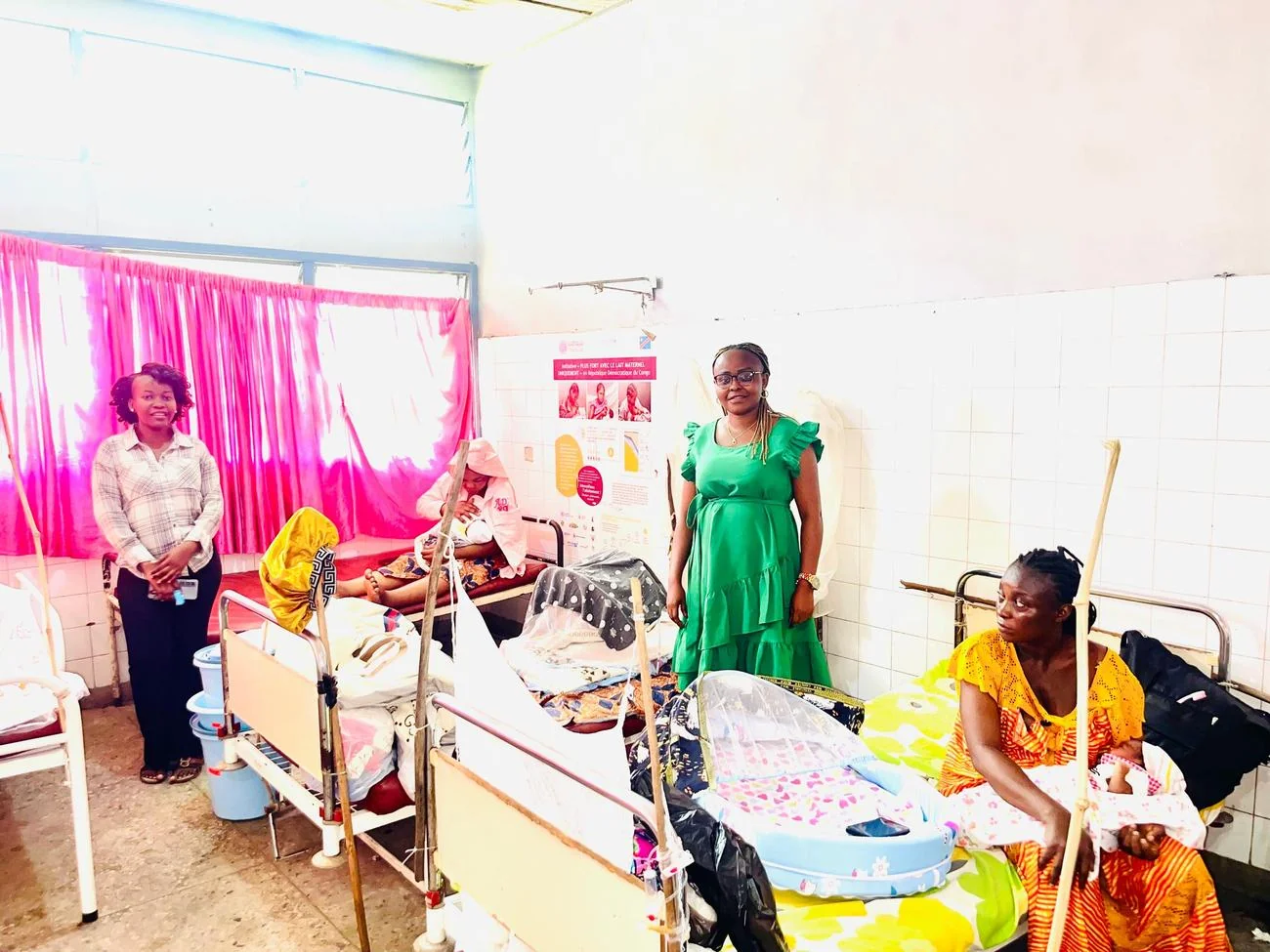
- CUK and CH Mont-Amba, Kinshasa
2
hospital sites in Kinshasa
1 : 2
one case for two controls
0 – 28
days: age of included newborns
12
months of ethical authorization
Background
A route of transmission that remains poorly documented
Breast milk contains a diverse microbiota, composed mainly of bacteria of the genera Lactobacillus, Bifidobacterium, Streptococcus and Staphylococcus. This ecosystem contributes to the maturation of the newborn's intestinal microbiota and immune system. Its balance can be disrupted by maternal, obstetric, environmental or therapeutic factors, leading to dysbiosis.
Long considered sterile, breast milk can constitute a source of transmission of pathogenic germs. Cases of neonatal meningitis and recurrent bacteremia due to group B Streptococcus transmitted through breast milk have been described, and a review covering fifteen African countries underscores that breast milk remains a neglected source of Listeria monocytogenes.
Research questions and objectives
Two questions, two hypotheses
Which factors promote dysbiosis of the milk microbiota, and what is the impact of this dysbiosis on neonatal infections?
Hypotheses
- Clinical factors (antibiotic therapy, mastitis, gestational diabetes, maternal infections, parity), nutritional factors (low dietary diversity, low intake of fiber and fermented products) and socio-ecological factors (limited access to safe drinking water, low income, breastfeeding hygiene practices) are associated with the occurrence of milk microbiota dysbiosis.
- Maternal milk microbiota dysbiosis is associated with an increased risk of neonatal infection in breastfed newborns, independently of other known obstetric and neonatal risk factors.
Overall objective
To study the factors associated with milk microbiota dysbiosis and evaluate its impact on neonatal infections among newborns cared for in the neonatology units of the Cliniques Universitaires de Kinshasa and the Centre Hospitalier Mont-Amba.
Specific objectives
- To characterize dysbiosis of the milk microbiota in mothers of infected children.
- To identify the clinical, nutritional and socio-ecological factors associated with this dysbiosis.
- To identify the germs responsible for neonatal infections.
- To test the relationship between maternal milk microbiota dysbiosis and neonatal infection.
Methodology
A case–control study of mother–newborn dyads
Newborns with neonatal infection are compared, in terms of exposure to maternal milk microbiota dysbiosis, with uninfected newborns matched by age group at a ratio of two controls per case. Recruitment is consecutive and exhaustive at both sites.
Sites and collaborations
The study is being conducted in the neonatology and maternity units of the Cliniques Universitaires de Kinshasa and the Centre Hospitalier Mont-Amba. Microbiological and molecular analyses are carried out through a collaboration between the INRB and the CREMER of the Université de Kinshasa.

Population
| Group | Definition |
|---|---|
| Cases | Newborn aged 0 to 28 days with confirmed neonatal infection, exclusively breastfed, and their mother. |
| Controls | Healthy full-term newborn, without major malformations or chronic disease, exclusively breastfed, and their mother. |
| Non-inclusion | Absence of exclusive breastfeeding, refusal of consent, prematurity or low birth weight in controls. |
Data collected
Sociodemographic
Maternal age, marital status, occupation, religion, address, area of residence.
Clinical
Maternal BMI, antibiotic therapy, mastitis, gestational diabetes, maternal infections, parity.
Nutritional
Dietary diversity score, intake of fiber, fermented products, animal protein and supplements.
Socio-ecological
Household income, access to safe drinking water, breastfeeding practices and breast hygiene.
Data are collected through structured interviews using the KoboCollect electronic questionnaire, supplemented by review of medical records for obstetric and neonatal data.
Laboratory analyses
From milk sampling to identification of the causative germ
Breast milk is collected using a standardized aseptic technique: cleaning of the nipple, discarding of the first stream and mid-stream collection into a sterile container. A neonatal blood sample is drawn by qualified healthcare staff. Samples are transported under cold chain to the INRB and CREMER laboratories.
Pretreatment and extractionMechanical lysis using FastPrep, chemical lysis with lipase, deglycosylation, followed by automated DNA extraction on EZ2 and quantification using Nanodrop.
Targeted qPCRDetection of pathogens of interest by real-time PCR on LightCycler 480.
Selective cultureEnrichment followed by isolation on selective media of positive samples, with identification of colonies by MALDI-TOF MS.
SequencingSequencing of the 16S rRNA gene and total metagenomics, with taxonomic assignment using Kraken 2 followed by re-estimation of abundances using Bracken.
Bacteria targeted by qPCR
The targets are the bacteria responsible for neonatal infections.
- Escherichia coli
- Klebsiella pneumoniae
- Enterobacter cloacae
- Serratia marcescens
- Staphylococcus aureus
- Streptococcus agalactiae
- Listeria monocytogenes
- Acinetobacter spp.
Analysis plan
Measuring the association between dysbiosis and infection
Descriptive analysis
Frequencies and percentages for categorical variables; means and standard deviations, or medians and interquartile ranges depending on the distribution.
Bivariate analysis
Comparison of cases and controls using the chi-square test and Student's t-test, with crude odds ratios and 95% confidence intervals. Significance threshold at p < 0.05.
Multivariate analysis
Conditional logistic regression accounting for matching, to identify factors independently associated with dysbiosis and then with neonatal infection. Results reported as adjusted odds ratios.
Tools
Data cleaning and statistical analyses in R (version 4.3.1), with double-checking of a sample of forms for quality control. Mapping with QGIS.
Ethical considerations
A protective framework for participating dyads
Ethical approval
Comité National d'Éthique de la Santé, Ministère de la Santé publique, Hygiène et Prévoyance sociale — Opinion No. 835/BN/PMMF/2026 of 13 November 2026. Implementation of the protocol authorized at the Cliniques Universitaires de Kinshasa and the Centre Hospitalier Mont-Amba from 13 November 2026 to 12 November 2027.
Administrative authorizations from the general and medical directorates of both sites, as well as from the neonatology, gynecology–obstetrics and laboratory services, are required before recruitment.
Written informed consent is obtained from each mother, in a language she understands, after information about the objectives, procedures, risks and benefits. Participation is voluntary, with the right to withdraw at any time without prejudice to the quality of care received.
Dissemination
Bringing the results back to those who decide and those who provide care
- Publication in a national and international scientific journal.
- Feedback to the pediatric services of the participating healthcare facilities.
- Presentation to national health authorities and donors.
- Presentation to the relevant health programs: Programme national de santé de l'enfant, Programme national de nutrition and Couverture santé universelle.
Team and partners
A collaboration between the INRB, the CREMER and the hospital sites
INRB / UMR MISTROP
Dr Nzungu Mananga Mathy
Principal investigator — INRB / UMR MISTROP
Partenaires
CREMER
Centre de Recherche et d'Étude des Maladies Émergentes et Réémergentes, Université de Kinshasa
Cliniques Universitaires de Kinshasa
Neonatology and maternity services
Centre Hospitalier Mont-Amba
Neonatology and maternity services
Contact and collaborations
For questions about the project, requests for scientific collaboration or access to data, please contact the UMR MISTROP coordination team.
How to cite this project
DYSMIL-NEO. Factors associated with dysbiosis of the milk microbiota and its impact on neonatal infections in Kinshasa. INRB / UMR MISTROP, Kinshasa, 2026.